
IB Grades Explained: What is a Good IB Score for Top Universities?
If you're an IB student, or the parent of one, understanding how IB grades are calculated and what universities actually look for is essential. The IB Diploma is one of the most rigorous pre-university qualifications in the world, recognised by leading institutions across the UK, US, and beyond. But the grading system can feel opaque, especially when university offers are expressed not just as a total score, but with specific Higher Level requirements and core component expectations.
This guide breaks down everything you need to know: how the 45-point scoring system works, what counts as a competitive score for different types of universities, why your choice of Higher Level subjects matters as much as your total points, and what to do if your results don't go as planned.
Whether you're just starting the Diploma Programme and planning your subject choices, or you're approaching results day and trying to understand where you stand, this article will give you the clarity you need to make informed decisions about your IB journey and your university application.
How the IB grading system works
The IB Diploma is graded out of 45 points. 42 of these come from your 6 subjects, each graded on a scale from 1 to 7. The remaining three points are awarded through the core components: Theory of Knowledge (TOK) and the Extended Essay (EE). Creativity, Action, Service (CAS) is a compulsory requirement but does not contribute to the final score.
Your TOK grades are combined with your EE grades as shown in the scoring matrix below. If you receive an E grade in either TOK or EE, you do not qualify for the IB diploma.
| Grade | Theory of Knowledge (TOK) | E | ||||
|---|---|---|---|---|---|---|
| A | B | C | D | |||
| Extended Essay (EE) | A | 3 | 3 | 2 | 2 | Failing condition |
| B | 3 | 2 | 2 | 1 | ||
| C | 2 | 2 | 1 | 0 | ||
| D | 2 | 1 | 0 | 0 | ||
| E | Failing condition | |||||
Example: A competitive IB applicant aiming for a top UK university
Below is an example of a student’s IB grade breakdown, including each subject, EE, and TOK. With a total of 41/45 IB points, this student is competitive for top UK universities.
| Component | Grade |
|---|---|
| Mathematics AA (HL) | 6 |
| Chemistry (HL) | 6 |
| Biology (HL) | 7 |
| English Language & Literature (SL) | 6 |
| Spanish B (SL) | 7 |
| Economics (SL) | 6 |
| Subject total | 38 |
| Extended Essay (Biology) | A |
| Theory of Knowledge | B |
| Core bonus points | 3 |
| Total | 41 |
This student's HL profile is 776, with their strongest performance in the subject most relevant to their intended degree. Their Extended Essay is written in Biology, reinforcing their academic focus. The 3 core bonus points, earned through strong TOK and EE grades, push the total from 38 to 41, which is the difference between a borderline and a competitive application for courses like Biomedical Sciences or Natural Sciences at a Russell Group university.
What is a good IB score?
To pass the IB Diploma, students must achieve at least 24 points and meet the following conditions.
You have no more than two grade 2s awarded (SL or HL).
You have no more than three grade 3s or below awarded (SL or HL).
You have at least 12 points on HL subjects.
You have at least 9 points on SL subjects.
Broadly, scores in the low 30s are considered solid and may be suitable for many universities and courses. Scores in the mid to high 30s are strong and can be competitive for a wide range of institutions. Scores approaching or exceeding 40 are exceptional and students are competitive for the most selective courses.
IB Grades are calculated from a mix of assessments, including coursework, final exams and practical assignments.
The total points distribution for IB grades is shown below:
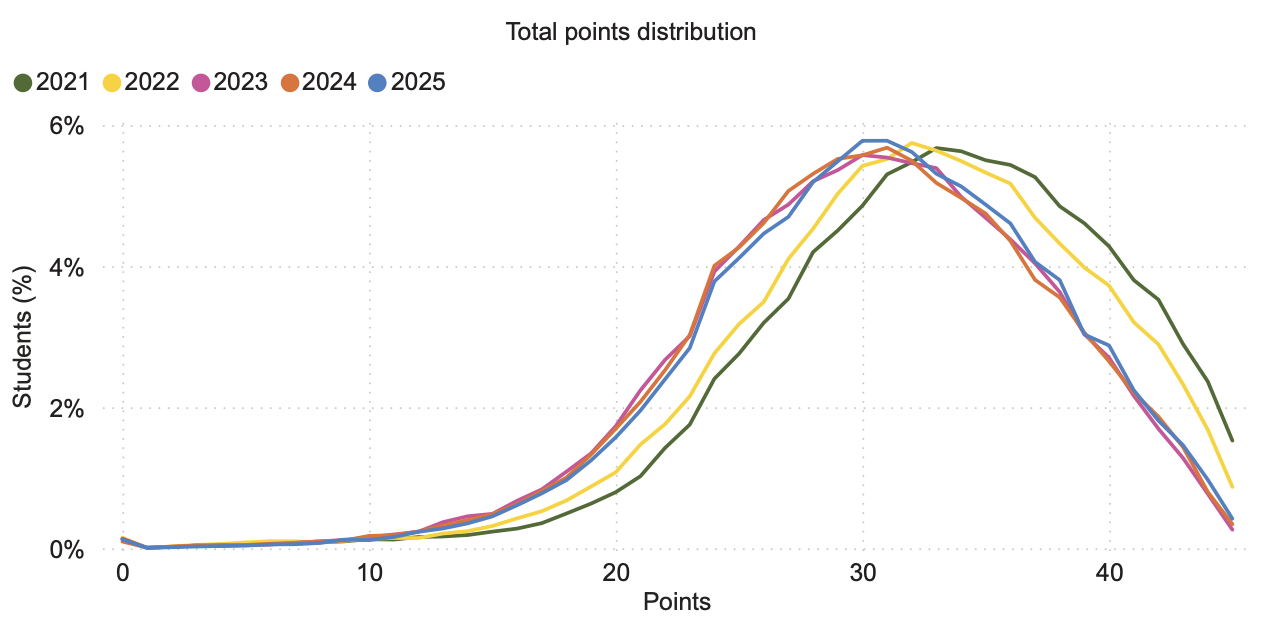
| Points | 2021 | 2022 | 2023 | 2024 | 2025 |
|---|---|---|---|---|---|
| 0 - 23 | 8.4% | 10.9% | 16.1% | 15.5% | 14.5% |
| 24 - 29 | 20.6% | 23.1% | 28.3% | 28.8% | 27.7% |
| 30 - 34 | 26.9% | 27.8% | 26.9% | 26.9% | 27.6% |
| 35 - 39 | 25.7% | 23.5% | 19.8% | 19.5% | 20.4% |
| 40 - 45 | 18.4% | 14.7% | 8.9% | 9.3% | 9.8% |
Why Higher Level (HL) subjects matter
For UK universities in particular, Higher Level subjects are often treated as the clearest indicator of academic readiness. Many offers are expressed not just in terms of total points, but with explicit Higher Level (HL) requirements. For example, one of our students applying to Cambridge for Natural Sciences (Biological) this year was offered a conditional offer of 43 overall with 777 in HL Biology, Chemistry and Mathematics, and 7 in SL English. Another of our students was offered a conditional offer of 42 overall with 776 in HLs, of which one of the 7s should be in Biology.
Higher Level subjects are usually most closely aligned with the degree you are applying for. A strong performance in relevant HL subjects often carries more weight than a slightly higher overall score with weaker subject alignment. A total score that looks impressive on paper may fall short if the HL profile does not meet course expectations.
Dr Geof Parks, Senior Tutor at Jesus College Cambridge published a report studying the correlation between IB grades and academic performance of undergraduates at Cambridge. The study results show that students with an IB score above 42 have significantly higher chances of doing well at Cambridge, as do students with HL scores of 775, 776 and 777.
Grade boundaries
IB grade boundaries determine the minimum marks required to achieve each grade (1-7) in an IB subject. They are not fixed but rather set each year based on the overall performance of students. This benchmarking ensures grades are awarded fairly regardless of how easy or difficult exams are set. In a challenging exam year, the grade boundaries might be lowered. In an easy exam year, the boundaries might be elevated. Grade boundaries are published online after each exam season.
If your IB grades are lower than expected, you have a few options:
Request a re-mark
Appeal your results
Retake exams/ take a gap year
Discuss with universities
We have a guide here on what to do if your IB results do not meet expectations.
Conclusion
If you’re thinking of taking the IB, now is the time to think strategically about your IB grades. Universities look not just at the final number but also your HL performance and subject alignment for your target major.
A good IB score depends on your aims. For some courses, a 35 is competitive enough. For others, particularly at Oxbridge or for Medicine, Engineering, Economics or Natural Sciences, realistic applicants are often looking at 41-42 with 776 or 777 at Higher Level. Knowing this early allows you to choose subjects wisely, prioritise the right HLs, and build an academic profile that supports your goals.
At First Class Education, we work with IB students not only to improve grades through subject tutoring, but also to align subject choices, HL strategy and supercurricular development with competitive university applications.
Though the IB Diploma is demanding, it is also one of the most respected qualifications globally. With the right strategy and preparation, your IB results can become a powerful foundation for admission to top universities around the world.
Frequently Asked Questions
-
The IB and A-Levels are broadly comparable but structured differently. A-Levels focus on three subjects in depth, while the IB requires six subjects plus core components (TOK, EE, and CAS). In terms of UCAS points, a score of 39 roughly equates to A*AA and 32 to BBB, with a grade 7 in an IB HL subject broadly equivalent to an A* at A-Level. Most UK universities accept both qualifications, but entry requirements differ, so always check at the course level.on text goes here
-
Competitive Oxbridge applicants typically need 41–43 points overall with 776 or 777 at Higher Level, though this varies by course. Cambridge also looks for strong core points (at least 2, ideally 3), and many courses require a 7 in a relevant HL subject. Always check the individual course page for the most up-to-date requirements.
-
The diploma is awarded to candidates who achieve a minimum score of 24 out of 45 and fulfil the other minimum requirements. These include:
Completing CAS
Earning at least a D in both TOK and the Extended Essay
Having no grade 1 in any subject
Meeting minimum HL point thresholds.
Receiving an E in either TOK or the Extended Essay results in an automatic fail regardless of your total points.
-
Yes. Grade boundaries are the minimum marks required to achieve each grade (1–7) in each subject, and these change annually based on the difficulty of the exam and overall student performance.
-
Together, TOK and the EE can add up to 3 bonus points to your total score via a combined matrix. The core elements (TOK, CAS, and the EE) play a major role in passing and earning the diploma; having a great subject score but failing to earn the core points can fail you entirely.
While many students treat TOK and the EE as secondary priorities, performing well in both can make a meaningful difference to your score, especially when competing for places at top universities where every point counts.
-
Yes, but the process goes through your school. If a candidate would like the IB to re-mark their work, they should approach their school's DP coordinator to place the request on their behalf. The IB cannot accept requests directly from candidates or parents.
Note that a re-mark does not necessarily result in a grade increasing, it can also remain the same, or even decrease. As there is a fee involved and a deadline for submitting a remark request, it is advised that candidates act promptly after results day.