
How to Prepare for the TMUA: Complete 2026 Guide
For students applying to mathematically demanding degrees, the TMUA (Test of Mathematics for University Admission) is one of the most important yet widely misunderstood parts of the UK admissions process. In today’s climate, strong A level, IB or AP grades are no longer good enough on their own and do little to distinguish candidates. Universities increasingly use admissions tests like the TMUA to separate between candidates who are able to apply maths flexibly and those who can only reproduce familiar methods.
This article breaks down what the TMUA actually tests, how universities use it and how students can prepare and excel in this critical part of the admissions process.
Contents
- 1. What is the TMUA and Why is it Important?
- 2. Which Universities and Courses Use the TMUA, and How are Scores Used?
- 3. What is the TMUA Format, and What Maths Do I Need?
- 4. What is a Good TMUA Score?
- 5. When Should You Start Preparing for TMUA?
- 6. Where and How Can You Sit the TMUA?
- 7. Tips and Tricks: Common Mistakes To Avoid When Taking the TMUA
- Conclusion
- Frequently Asked Questions
1. What is the TMUA and Why is it Important?
Many applicants to top UK universities apply with strong personal statements, good references and excellent grades. With so many qualified applicants competing for limited spots at top universities, the TMUA is one way that differentiates between candidates.
Unlike the A levels, IB or APs, the TMUA assesses your mathematical thinking ability, not just syllabus coverage. Universities use it to evaluate how students reason, make decisions under time pressure, and work through unfamiliar problems using core mathematical concepts. The TMUA focuses on logical reasoning, fluency with algebra and functions, precision and accuracy, and the ability to eliminate incorrect options efficiently.
For competitive courses at top universities, the TMUA is used before the interview to shortlist candidates.
2. Which Universities and Courses Use the TMUA, and How are Scores Used?
The TMUA is a shared admissions test used by many top universities in the UK. Which course requires the TMUA can sometimes change from year to year, but the common ones are:
Mathematics
Computer Science
Economics
Engineering
Universities use the TMUA at different stages of the admissions process, and the way it influences decisions varies by institution.
At Cambridge, the TMUA is used to help shortlist candidates for interview and is then considered again when making final offer decisions. At Imperial, where most applicants are not interviewed, the TMUA plays a more central role in determining who receives an offer.
At several universities, a strong TMUA score can lead to a reduced offer, meaning you would need lower A-level grades to meet your conditions. Durham, Warwick and LSE all operate systems where high-scoring applicants may receive offers one grade below the standard entry requirements. This makes the TMUA one of the few admissions tests where a strong performance can directly lower the bar you need to clear on results day.
For universities where the TMUA is optional, such as certain courses at Warwick and Durham, choosing to sit the test and scoring well provides additional positive evidence of your mathematical ability, while not sitting it will not count against you. However, at universities where the TMUA is compulsory, such as Cambridge and Imperial, your score will always form part of the decision and cannot be withheld.
Below is a list of universities and courses that accept the TMUA:
| University | Courses Requiring TMUA |
|---|---|
| University of Cambridge |
|
| University of Oxford |
|
| Imperial College London |
|
| University College London |
|
| London School of Economics |
|
| University of Warwick |
|
| University of Durham | Optional for Mathematics, Mathematics & Statistics |
The TMUA was previously run by Cambridge Assessment Admissions Testing (CAAT) but has now been taken over by Pearson VUE, under the University Admissions Testing (UAT), which also runs the Engineering & Science Admissions Test (ESAT), Test of Academic Reasoning for Admissions (TARA), University Clinical Aptitude Test (UCAT) and the Law National Aptitude Test (LNAT).
From 2026/27 entry onwards, Oxford has changed all its internally assessed tests to standardised tests such as the TMUA, ESAT and TARA. You can find more information in our post about Oxford’s admissions test changes.
It should also be noted that for 2027 entry, Cambridge now requires the TMUA for their Mathematics course, alongside STEP if a candidate receives an offer.
3. What is the TMUA Format, and What Maths Do I Need?
The TMUA is a computer-based test lasting 2 hours 30 minutes in total. It is divided into two parts, each consisting of 20 multiple choice questions.
Applications of Mathematical Knowledge
Mathematical Reasoning
Questions across both papers carry equal weightage. Calculators or dictionaries are not permitted, there is no formula booklet and you do not lose marks for wrong answers. Questions are designed to test speed, judgment and reasoning. Often, several answers might seem plausible and students must decide which approach is most mathematically sound.
You can find a compilation of the specification and past paper questions on our TMUA preparation page.
While the TMUA covers mathematical concepts typically taught at A-Level or IB, you might encounter questions on topics your school hasn't covered yet. If this happens, you'll need to teach yourself these areas to ensure you're fully prepared. Below is a summary of the TMUA topics. For a complete breakdown, check the TMUA specification.
Algebra and functions
Sequences and series
Coordinate geometry in the x-y plane
Trigonometry
Exponentials and logarithms
Differentiation
Integration
Graphs of functions
Units
Number
Ratio and proportions
Geometry
Statistics
Probability
Logic and proof
4. What is a Good TMUA Score?
The TMUA is considered alongside other aspects of your application such as your academic background, supercurricular profile and personal statement, and compared to other candidates in the applicant pool for that year. There is no pass mark or cutoff score.
Having said that, the TMUA is scored from 1.0 to 9.0, with 5.4 being the average score in previous years. The scale is designed such that approximately a third of candidates will achieve scores higher than 6.5. Thus applicants should aim for a score of above 7.0 to be competitive. A strong score can significantly strengthen an application, while a weak score can raise concerns even for students with strong academics.
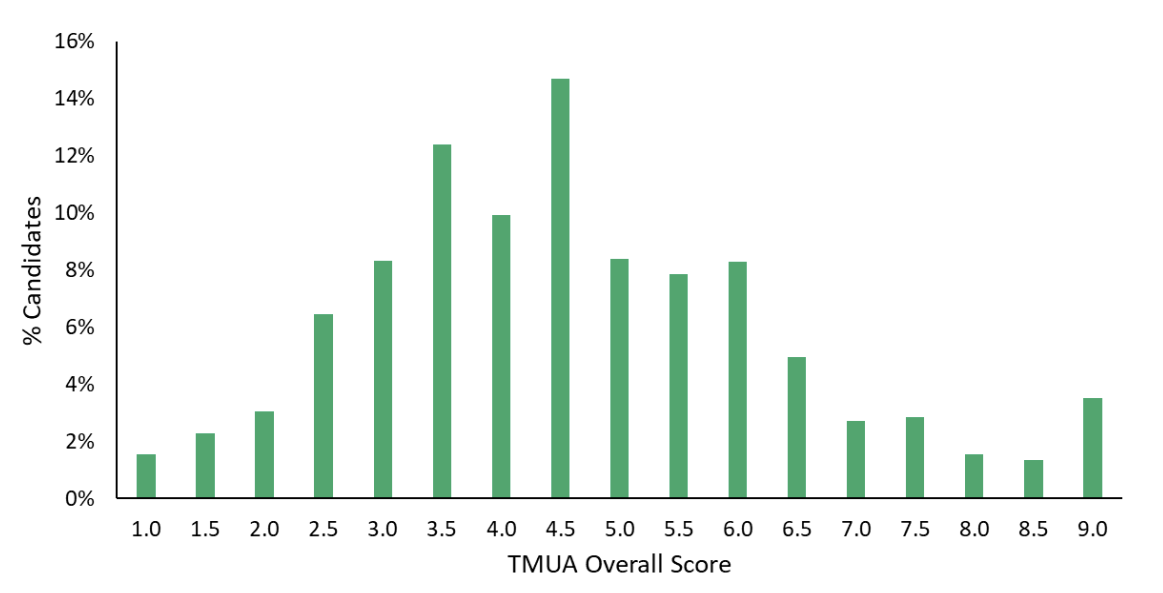
October 2025 score distribution
5. When Should You Start Preparing for TMUA?
Unlike school exams, the TMUA does not reward memorised methods or syllabus coverage. It tests how well you can apply familiar mathematics in unfamiliar ways, under strict time pressure. Developing this kind of problem-solving takes time and practice.
For most students, an ideal starting point is March to June of the application year. Starting early allows students to practise recognising patterns, structuring solutions efficiently, and avoiding common traps, rather than rushing through large volumes of questions close to the test date.
Students who delay preparation until the final few months often do badly in the test. Without enough time to reflect on mistakes and adjust approach, practice becomes repetitive rather than productive. Early preparation creates room for steady improvement.
Targeted guidance and structured feedback can significantly accelerate progress. Students who plan ahead and refine their approach over time place themselves in a far stronger position than those relying on last-minute practice alone. For those who want to prepare, check out our TMUA resources page.
6. Where and How Can You Sit the TMUA?
You can take the TMUA at authorised test centers internationally. Students should register early and be mindful of clashes with other admissions tests. While there are two available dates for sitting the TMUA, you can only sit the test once per admissions cycle. This means if you sit the TMUA in October, you cannot sit it again in January. You would have to reapply to again the following year.
Students applying to Oxbridge (UCAS deadline October), you will
Book the test by September
Take the test in October
Results released in November
If you are applying to other universities (UCAS deadline January), you would
Book the test by December
Take the test in January
Results released in February
You can register for your test on the UAT website .
The cost of the TMUA depends on where you sit the test, not your nationality or residence:
UK and Ireland: £75
Rest of world: £130
UK candidates who face financial hardship can apply for a bursary voucher through the UAT-UK website, which covers the full cost of the test. Bursary applications must be submitted before you book your test, so make sure to apply early.
7. Tips and Tricks: Common Mistakes To Avoid When Taking the TMUA
Even strong mathematicians underperform in the TMUA due to avoidable errors. Being aware of these common pitfalls can make a real difference to your score.
Spending too long on one question: With only 3 minutes and 45 seconds per question on average, getting stuck on a single problem is the most common way students run out of time. Every question carries equal weight, so spending 10 minutes on a hard question while leaving easier ones unanswered is a poor trade-off. If a question is taking more than 4–5 minutes, flag it and move on.
Leaving questions blank: There is no negative marking on the TMUA, so a blank answer is always worse than an educated guess. Even if you are unsure, eliminating one or two implausible options and selecting from the rest gives you a reasonable chance of picking up marks.
Careless arithmetic and sign errors: Without a calculator, small slips, like a misplaced minus sign, a wrong index, a rounding error, can cascade through your working. The examiners are aware of this: common arithmetic mistakes are deliberately included among the answer options to catch students out. Write your working clearly, even on rough paper, and double-check the final step before selecting your answer.
Defaulting to familiar methods instead of thinking about the question: Many students try to force A-level techniques onto TMUA questions rather than stepping back to consider the most efficient approach. For example, a question that looks like it requires a long algebraic solution may be solved almost instantly by sketching a graph or substituting values. The TMUA rewards flexible thinking, not procedural repetition.
Neglecting Paper 2: Paper 2 tests mathematical reasoning and logic, which most students have far less experience with than the pure mathematics in Paper 1. Questions on necessary and sufficient conditions, identifying errors in proofs and constructing counterexamples requires different skills that must be practised specifically. Students who focus all their preparation on Paper 1 content often lose marks unnecessarily on Paper 2.
Using advanced methods that overcomplicate the question: The TMUA syllabus is based on AS-level content with a few additions from A2. Students who try to apply Further Maths techniques like compound angle formulae or advanced integration methods often make the problem harder than intended. The questions are designed to be solved with first-year methods, if your approach feels overly complex, there is probably a simpler route.
Conclusion
For students who have strong grades but weaker problem-solving confidence, or students who are applying to competitive courses, structured guidance can help you focus on the right skill and practice in a targeted manner. Starting preparation early and getting training and feedback from experts can give you an advantage in this challenging test.
The TMUA is designed to identify students who can think mathematically under pressure and adapt when facing unfamiliar problems. These are the very students who will thrive in mathematically demanding degrees. Students who perform ones prepare deliberately and approach the test strategically, treating it as part of their wider admissions strategy.
Sources
Frequently Asked Questions
-
You can book the TMUA through the official UAT website. You can sit the TMUA at authorised computer-based test centers worldwide. Registration opens several months before each sitting. It’s important to register early and double check that the test date does not clash with other admissions tests or school commitments.
-
Unlike the A levels, IB or APs, the TMUA assesses your mathematical thinking ability, not just syllabus coverage. Universities use it to evaluate how students reason, make decisions under time pressure, and work through unfamiliar problems using core mathematical concepts. The TMUA focuses on logical reasoning, fluency with algebra and functions, precision and accuracy, and the ability to eliminate incorrect options efficiently.
For competitive courses at top universities, the TMUA is used before the interview to shortlist candidates.
-
The TMUA is a paid admissions test. Sitting the TMUA within the UK costs £75, and £130 if the test is taken internationally. Exact fees are published each year on the official admissions testing website and should be checked before registration.
-
TMUA results typically come out around four to six weeks after the test sitting, released via your UAT-UK dashboard and notified by email, with October sitting results usually in mid-November and January sitting results in mid-February. Your grades will automatically go to universities like Cambridge and Oxford.
-
The TMUA is scored from 1.0 to 9.0, with 1.0 being the lowest score and 9.0 being the highest score. 5.4 is the average score in previous years. The scale is designed such that approximately a third of candidates will achieve scores higher than 6.5. Thus applicants should aim for a score of above 7.0 to be competitive. A strong score can significantly strengthen an application, while a weak score can raise concerns even for students with strong academics.
-
Most successful applicants prepare for the TMUA over several months, rather than weeks. Because the test focuses on reasoning and problem-solving rather than content revision, improvement takes time. Preparation is most effective when it is consistent, reflective, and supported by feedback, rather than based on last-minute practice alone.
-
The TMUA consists of two papers, each lasting 75 minutes. All questions are multiple-choice and non-calculator. On average, students have just over two minutes per question, which means efficient decision-making is crucial.
-
Multiple sittings exist to accommodate different application timelines. However, most universities will only consider TMUA scores from the sitting relevant to your application cycle. Sitting the TMUA multiple times does not usually provide an advantage unless explicitly permitted by the university. Students should always check which sitting is accepted for their intended course before registering.
Students applying to Oxbridge (UCAS deadline October), you will
Book the test by September
Take the test in October
Results released in November
If you are applying to other universities (UCAS deadline January), you would
Book the test by December
Take the test in January
Results released in February
-
The TMUA is not harder in terms of content, but it is more demanding in terms of thinking. Questions are based on material students have typically encountered at school, but they are presented in unfamiliar ways and under tighter time pressure. Many high-achieving A-level or IB students find the TMUA challenging and may benefit from expert guidance.
-
Calculators are not allowed when taking the TMUA.
-
For Cambridge Mathematics, candidates are required to take the TMUA in October. If candidates are given an offer, they must also sit the STEP in June alongside A levels/IB.